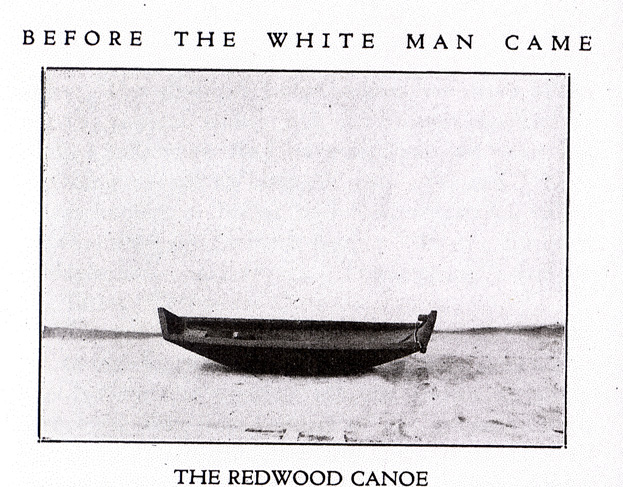
The Redwood Canoe

redwoodcanoe-min1
by Charles S. Graves
from Before the White man Came c1934

The redwood canoe as made by the Indians of the lower Klamath is the most artistic of all the caoes used by the different tribes, and is made in this manner:

They select a log of suitable size and split it in half. They then take one half and trim it down, top and bottom un til they get it in proper shape. They then hew out the inside until they have it on an equal thickness. then they cut out the seat, leaving two cleats to brace the feet afainst when rowing or when using the paddle. The paddle is used for rowing, they do not use oars. A hole is made in each corner of the canoe, through which a haxel withe is put around the end of the canoe and drawn very tight. Thius prevents the canoe from splitting should it strike a rock.
In operating the canoe, the Indians believe that it should have a heart, otherwise it would be a dead boat. So he leaves a round knob about three inches across a short distance back from the bow and so long as the heart is there he feels safe, knowing that the canoe is alive.
The canoe pictured here is the property of the author (Charles S. Graves).

Our Log Memorial High School – 1933

loghs1902
by Judy Bushy

The Log Memorial Building on 4th Avenue & East Street is an important part of Happy Camp’s History. It shows how one man with a vision of giving the young people of Happy Camp an education could enlist the support of many community members. Out of the unity of working together towards that purpose, great things were accomplished. Times looked bleak in 1933 and the country was in the great depression, but that obstacle didn’t stop the community from completing a high school in Happy Camp.

In 1922 Gorham Humphreys started a school for Happy Camp Students that included the first two years of high school. The classes were held at the local grammar school. Mr. Taylor was the school’s first teacher. He was followed by Miss Rudd who taught for four years. The two year course was discontinued in 1928 for about three years, according to Justice Court Judge Philip Toleman. He spoke at a dinner served by the high school home economics department.

Humphreys obtained re-establishment of the two year high school after campaigning at his own expense to the district board. There were about 30 students then and they needed a four year course and a separate place from the grammar school which was also overcrowded.

On March 3, 1933 with all the banks in the country closed and the depression in full swing, Gorham Humphreys, Dr. Mason and Judge Toleman presented to the district board the Grange plan to get people together to build a school for Happy Camp. Toleman said that, “the board had a really a tough row to hoe, taxpayers were broke and appeared to request all expenditures be cut to the bone.” Still, Ed Kaupp of Mt. Shasta helped turn the board in favor of the project and they promised $500 for the purpose.

Bert Newton donated the land, helped build the Log High School and lost his life due to illness contracted when serving at a school activity. Bert Newton started freighting with horses from Hornbrook to Klamath River points in 1910. From 1919 to 1930 he carried mail and parcel post from Hornbrook to Happy Camp, buying freighter franchises from Walter Bower and George Howard. By 1927 a new era arrived—the automobile replaced horses everywhere—so that spring he turned 57 head of stage horses loose with a herd of wild horses on the Bogus Range. He couldn’t even give them away!

Meanwhile, in 1920, he and his partners, his brother I.S. Newton and Harry Pence, purchased most of the unimproved land in Happy Camp. They erected a store, some cabins, a campground and a saw mill. He built the first building on what is now the Happy Camp Ranger Station at 2nd Avenue and Airport Road and leased it as headquarters to the Forest Service for many years. The Log High School was then where the present high school is located.

Gorham Humphreys initiated the idea of the high school building and must have been able to convince many in the community of the value of proceeding to build, as it seems the community worked together with uncommon unity.

Logs for the new log high school were donated by the Forest Service and cut under the direction of Bob Titus. Toleman was in charge of the building operations. Milt Fowler set the foundation forms. Gravel was hauled by Ralph Gordon. Pete Grant, Mike Effman and others chopped notches in the logs. When things got “bogged down” in August (of 1933) men weren’t able to come when needed and a few forgot they had pledged a certain amount of labor. Many in town thought maybe they had “bitten off more than we could chew…” That is when the women of the Grange put on a couple of noon picnics to get a large group together to put on the roof. Other women encouraged the work on optimistically. Ora head (Mrs. Guy Head) encouraged the workers to stay with it, urging all to remember that “Rome wasn’t built in a day!”

In September, two large classrooms were ready for Mr. Lowe and Miss Fite, the teachers, to begin classes. The people of Happy Camp had built a high school for education of its young people with only about $1,000 from the District Board.

In November of 1933 a dedication was held. At that time, Toleman said, “we were hearing a lot about the age of rugged individualism that was past. At this time I would like to say that it was that spirit, combined with a will to help each other, that did the job. And in passing I believe that it is proper to note that the teachers who lead in the education of our youth and who at times may wonder if their efforts are really appreciated cannot help but feel that the answer is YES, when they have occasion to work in or even hear of a high school that has grown under the conditions that this one has here in Happy Camp.”

The first graduating class in 1935 included Mae Barney, Marshall Vanhoy, Ruth Baker, Robert Humphreys, Nina Sedros, Edna Fowler, Paul Good, Geraldine Titus, George Logan and Florence Sutcliffe.

Gorham Humphreys must have felt great happiness when his son, Robert, was one of the first graduates of the school. He had seen a need for a high school and enlisted others to work with him to bring his vision to reality. Several of his children had died but his surviving four daughters and son had a great example of a father’s concern for their education. Of his daughters, Bertha married Tom Carter who was Forest Ranger. Viola became a nurse, Aurelia was a teacher and Hazel went to college in Marin County and then married Finley Joyner. The son, Robert, who graduated in 1935 died in Italy on the last day of the war in Europe.

Eventually a new high school building was needed. The principal, Arthur French, said “For two and one-half years teachers and equipment have been crowded together into 2,400 square feet of floor space.” The new building was expected to cost $438,000 and the bond bill was to be voted on according to the April 16, 1955 Klamath River Courier. “The new facility provided a large modern home economics room and a complete science room. It would also allow development of a commercial department and library.” Dr. Jere Hurley, Superintendent of Siskiyou County’s Joint Union High School District gave the speech dedicating the new building to “the principles of democracy and the Constitution of the United States, to all students –past, present and future.” Short addresses were also given by Sharon Titus, Carol Evans and Gene Erskin of the High School Student Board.

The old Log Memorial Building was to be moved to another site, and perhaps used for a library or museum. It was believed to be the only high school building constructed of logs still in use at the time. When “Old Timers” look at the Log Memorial Building they recall how the whole community united in the effort to bring education to our children.. It’s amazing what can be accomplished when we work together toward our goals!
Cycle OR LOVES biking to Happy Camp!!

Judy Bushy

High Expectaions were in the air Sunday afternoon. On Park Way the crews had put up tall poles with brightly colored fabric, red, blue, yellow and green, waving in the wind. It was quite a sight. After my morning classes, Monday at Old Town Park we saw a number of booths set up with food to offer hungry cyclists. At that time, no cyclists had arrived.

Shortly after noon Monday a few brightly clad bicyclists began to appear. It stood to reason that a ride from Yreka that takes nearly a couple of hours by car would take cyclists longer! They seemed intent on going directly to the finish line although they had to go around town in a circular route before climbing Headway Hill, one last rise, before the last leg of the ride down Park Way .

There was food that could have fed several thousand hungry cyclists, I’m sure! The Klamath Knot Center had sandwiches, The Campus Life Club had brownies and pies and other baked goods. The Happy Seniors had punch cards and pies. Beautiful pies, All sorts of pies, Oh they looked good!

Betty Fayette and Tina Sherburne had a food booth. Dolly Elston had sausages and curly fries. Lisa West and Company had Teriyaki chicken on a stick with salad bar and SNO CONES!! She was also assisted by a number of young people and one young Sasquatch!! It was the Sasquatch that loved to jump out in front of the cyclists and surprise them!! More and more cyclists began to arrive until five o’clock when most of the cyclists had arrived or were being offered pick up rides to get to camp.

After interesting conversations at Old Town Park I went to the Elementary school and saw the finish line the cyclists were rushing to get to!! There Nadine and Co. had the Dear Mad’m mining cabin (from last weeks Jamboree parade) set up as an information booth. They were there answering questions and welcoming all the people– of which there were many. Displays booths had all sorts of Cycle Oregon memorabilia from socks to hats and some mighty nice T-shirts with a map on them, in case one got lost on the road!!! Ha!

These cyclists are serious about their bikes however, and more booths were set up to take care of the bikes!! There were also programs for mentoring young people as well as other causes and first aid help available.

Down to the park. Trisha Barnes, and her mother, Nida Johnson were there selling autographed copies of Trisha’s book, Klamath Treasure. They seemed the busiest booth there. There were also photographs, handcrafted jade jewelry, tie dyed shirts, books, and all sorts of things from refrigerator magnets to massages were being offered. The massages seemed to be the most popular with the bikers!!

Monday was not the end of the Cycle Oregon experience. I also had been asked to help out at breakfast. Now, us Mom’s are always ready to help serve hungry people, but at 4:35 in the morning?!? We assembled for hairnets, aprons and instructions before dawn. The cyclists were fed a hearty breakfast of bacon, cheese omelets, 7 grain oatmeal and other cereals, coffee, juice fruit and yogurt. It was something for everyone, especially coffee. High School Seniors were helping out in this way to fundraise for their senior trip to Hawaii before they graduate next June.

Finally the sun came up and we could see more clearly the visitors to our community. They were such a friendly bunch of people, and all had a kind word of appreciation that you wished you had all day to visit. However, they were also eager to be on the way UP, and I do mean UP over Greyback Road to Oregon . We bid them adieu and hope they may come back to Happy Camp in coming years.

By eight o’clock it was time to go to work at Happy Camp High School. Unfortunately after four hours of bussing tables, I didn’t have to ACT like a “senior citizen” for dress up day at School on Tuesday!! Bonnie Alvarez was all dressed up as a nurse to take care of the students who were dressing as “senior citizens.” Many of them were packing up the luggage that they had unpacked the day before, but before long they showed up back at school to hit the books with a regular school day.

Siskiyou Pioneer Hot off the Press!!

Siskiyou Pioneer Annual printed on Klamath River families.

Siskiyou Pioneer Annual printed on Klamath River families.

It’s a beautiful, cool but sunny day in Happy Camp, although there were rumors of a dusting of snow over Greyback Tuesday. It was a clear moonlit night last night coming home. Still, it is now October first, so we must enjoy these sunny days while we can! It was a great quickly trip out of town–Learned a lot and accomplished a lot of errands.

The best part was stopping by the Siskiyou County Museum and got a brand new “hot off the press” issue of The Siskiyou Pioneer from the Siskiyou County Historical Society. This issue (2009) is Gold Rush and Mixing of Cultures in Western Siskiyou County .

The front cover has a photo of Fred Emet Johnson at 17 with his mother. Fred is “third generation from the first white man into the Klamath River area.” His mother is “Tall Julia,” also known as Julia Goodwin Stanshaw Johnson Bell. Since Fred was born in 1905, that means the photo was taken about 1922. After reading “Land of the Grasshopper Song” Fred took a notebook full of notes which his daughter Joy shared.

Rumors had been floating around that Hazel Davis Gendron was writing new history information about this area and this is it. I was greatly looking forward to it. She was joined by Cheryl M. Beck in compiling the book.

First of all it was the photo of Hazel Humphries Joyner holding a photo of her brother, Robert (in the information about Karuk men who had been killed in action in past wars) that was of special interest. Then the forward was a wonderful tribute to the enduring Karuk people.

The balance of the book tells of ten or eleven families, mostly from the Klamath River . One of the difficulties in writing about these families is the belief of some that even mention of the name of deceased relatives may bring bad luck. But the ladies are good genealogical detectives/trackers and found data in formal BIA records which helped.

There are also stories of Squirrel Jim, Tribal Basket Makers and how important music was to people.

If you have membership in the Siskiyou County Historical Society, you are in for some interesting reading when this new edition comes to you. If not, you could join for $25 and receive the new issue next year. Last year’s issue centered on Doris and each issue is a different topic about the history of Siskiyou County.

The Story Behind Dear Mad’m

Stella Patterson
Stella Walthall Patterson
October 14, 1866 –
December 23, 1955

By Judy Bushy

This weekend we took a drive down Highway 96 just to enjoy the sunshine on the River, and the forest and blue skies. We came to the pullout near where Stella Patterson had her cabin and stopped to enjoy the view.

At the time of her eightieth birthday, Stella W. Patterson was faced with a dilemma. Her decision involved when a person is OLD and how she wanted to live her “senior years.” Stella made a surprising decision and became a hero to seniors who have since loved her book, Dear Mad’m.

Stella was born October 14, 1866 in the bustling city of San Francisco. Stella enjoyed the urban opportunities for social and cultural life, but after the earthquake of 1906 she left the city.

At the time of her 80th birthday, while visiting friends in Arcata on the northern coast, she was invited to live with relatives eager to do for her and take care of her in “declining years.” When a doctor told her that she had “young legs” it set her thoughts in a different direction. She owned a cabin on a mining claim in the wilds of Clear Creek near the friendly little town of Happy Camp, on the Klamath River. She decided to give living in that little cabin a try for a year. She wrote to the caretaker and set off for Willow Creek where she rode with the mail delivery up to the mailbox on Highway 96 below the cabin.

The title of her memoir of life on the Klamath came from, perhaps a senior moment, when Fred, the caretaker arrived, and she’d forgotten his name. In her correspondence she had said, “Dear Sir,” so she fell back upon that salutation. Fred replied, “Dear Mad’m,” and thus the nickname, which was later to become the title of the book, began.

The book tells of her life in that solitary and somewhat primitive cabin in its beautiful surroundings. She lived alone there with her dog, Vickie, and it turned out she had many adventures.

While Stella Patterson still traveled some, her delight was to return to her little cabin on the Klamath. She loved to garden and put up jams and jellies. She sent the memoir of the year she moved to the cabin to agents, critics, and finally a New York publisher who edited it. She called it “slashing,” her story. In the fall of 1955 she moved to an efficient little travel trailer, near Everett and Thelma (who had been like a daughter to her) in Redding. Her life drew to a close there in December 23, 1955 at the age of 89. It was just two weeks before Dear Mad’m was to be published, January 6, 1956.

The book had far reaching effects. It became a popular book club selection. Three ladies from Chicago retired from the Telephone Company and came to live near Happy Camp, because of reading her story. They enjoyed gardening and artistic endeavors and were active in the community. They were loved and appreciated in the community although they too are gone now. When Highway 96 was improved and straightened (Yes, it is possible that there were more curves and corners!) the road went right through her cabin, which was moved out of the way.

Naturegraph, a local Happy Camp publisher, kept the book in print since that time, for which we are grateful. Stella was a hero of sorts to persons of mature years, who still have more years to appreciate life and blessings. It’s a good book to read to remind a person of all the wonderful reasons we love life on the lovely wild Klamath River at the top of California.

Sheriff Riggins Promises “We won’t leave you out there!”

One strange phenomena of small towns, is the rumors! Rumors can fly faster, spread quicker and be more unbelievable, yet believed, than you could imagine. The rumor that has been flying around our community since economic times have hit the nation, California and especially Siskiyou County: “Will Sheriff Riggins shut down our Sheriff substation?”

At the July meeting of the Community Solutions to Alcohol and Other Drug Abuse meeting, he sent a representative to say that they would not be abandoning the Happy Camp substation. The problem is that there will no doubt be cuts in personnel, including within the Sheriff Department. This will be determined after California passes a budget. If there are personnel cuts, the last hired are the first to go. there is no choice in that as by regulations, last hired go first. We have some very good deputies here, but they are young men who have just moved to Happy Camp. If they have to be laid off, staffing will have to be sent out from Yreka. This means extra travel time for a Deputy. They also work together with the California Highway Patrol and Fish and Wildlife officers in the community to be sure we have law enforcement personnel here on call when needed.

While the situation looks discouraging with the thought of losing the officers, there was talk of reviving the Neighborhood Watch program that successfully kept crime down during a short time of increase in home break-ins. Patrolling had gotten too expensive and the volunteers were mostly senior citizens. That aspect of the program was seen as less desirable than educating the public on how to be a good witnesses and on what suspicious activities to watch for and report. Community action was looked upon as the best way to supplement Sheriff’s deputies, as long as it didn’t evolve into vigilantism!

1 … 8 9 10 11 12 13