Siskiyou Crest National Monument–Let’s look honestly at the plan.

This is the reply to the position of Laurel of Klamath Siskiyou Wildland Center from Tom Waddell. Tom Waddell is well known and respected member of the Happy Camp/Klamath River Valley community for his community involvement and wisdom. He is well qualified to speak to this matter, as you will see in his introductory remarks.

I am a Karuk Tribal Member and on the non-native side of my family I am a fifth generation Happy Camper. I would like to respond to the email you sent to Rita at the Happy Camp Chamber.

Over the past twenty years I have been directly affected by those who wish to force their views on others. Those who keep saying that there will be little to no impact and there is potential for a positive economic effect. In fact we have been told that story on every new proposed change in public land management policy. Ask Rita if recreation is supporting a strong econony in Happy Camp. Study after study told us how recreation was going to replace the jobs lost under Clintons Forest Plan. How did the small amount of grant funds made available create long term economic development? LETS TALK HONESTLY.

I would be happy to meet with you and any economist that you choose, to debate the effects that have been forced on the Klamath River Communities over the last 20 years. Lets have an honest conversation where truths are the basis for discussion and the effects are not hidden behind closed doors. Lets talk about the “trickle down” effects that Dr. Robert Lee from the University of Washington researched and reported on the adverse effects on small rural communities when their economies collapse like they have along the Klamath. Lets talk about the social challenges that the Happy Camp Family Resource Center deals with every day. Lets talk about the sharp escalation of crime rates, drug and alcohol use, suicides (and attempts), and other social ills.

After we have completed some honest conversation about historical facts on the effects on local economies over the last twenty years then I will patiently listen to what you and your economist has to say about our communities. I will listen to the “projected” effects if the project that you are promoting is implemented.

I am a business counselor and I work with clients who are researching the feasibility of businesses everyday. When we work with a business the first thing we request is historical data, because it gives us an insight into the future. Try getting a loan from a bank for a startup business with no previous business experience. It simply won’t happen.  They want to be able to reasonably predict what the business will accomplish. Historical information is the  best way to predict what will happen.

So lets talk about the effect restricting access and land management has had  on the residents of the Klamath River Corridor over the last twenty years.  Then lets use that information to extrapolate what might happen in the next twenty years if further restrictions are implemented. If we continue down the same path of restrictions we may even reach the point where the economy is sooooo bad that we might see a positive effect from one of those land management decisions, but there will probably be so few actual productive residents in the area that no one will be here to notice or to celebrate (PROTEST). Which is the “Hidden Agenda” of most Special Interest Groups such as yours.

My family homestead has been left to slowly reach a state of disrepair. Three of us brothers have relocated their families out of the area, the same as most of my first cousins and their families. Since my mother had thirteen brothers and sisters that is quite a crowd that has had to leave the “River” (our home for thousands of years).

I work in Redding, CA and commute home every weekend to try and maintain my families homestead. I also split my time to visit my son and granddaughter who had to move out of the area. Tell me again that it will not have an effect!
Let us talk honestly!
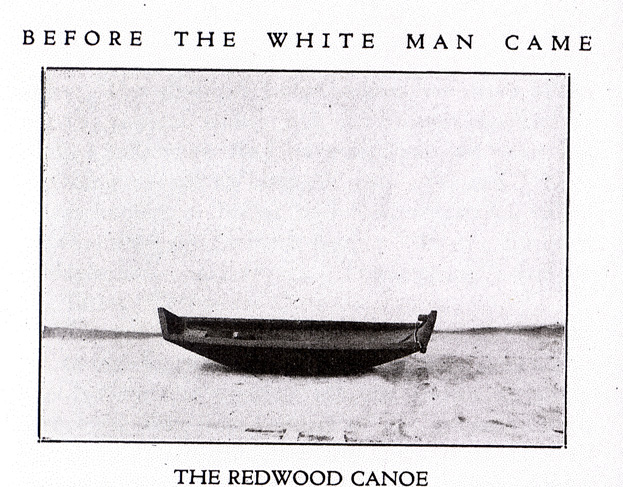
The Redwood Canoe

redwoodcanoe-min1
by Charles S. Graves
from Before the White man Came c1934

The redwood canoe as made by the Indians of the lower Klamath is the most artistic of all the caoes used by the different tribes, and is made in this manner:

They select a log of suitable size and split it in half. They then take one half and trim it down, top and bottom un til they get it in proper shape. They then hew out the inside until they have it on an equal thickness. then they cut out the seat, leaving two cleats to brace the feet afainst when rowing or when using the paddle. The paddle is used for rowing, they do not use oars. A hole is made in each corner of the canoe, through which a haxel withe is put around the end of the canoe and drawn very tight. Thius prevents the canoe from splitting should it strike a rock.
In operating the canoe, the Indians believe that it should have a heart, otherwise it would be a dead boat. So he leaves a round knob about three inches across a short distance back from the bow and so long as the heart is there he feels safe, knowing that the canoe is alive.
The canoe pictured here is the property of the author (Charles S. Graves).

It’s the Most Wonderful Place in the World!

Happy Camp is a friendly little town at the top of California. It is a beautiful place. Some, like Dennis,  say it is a majestic place. The wild Klamath River winds its way from Oregon to the Coast surrounded by evergreen forests beneath a beautiful azure blue sky. Last trip down the river there were several foxes crossing the road, which I like to see, and a skumk which I’d rather avoid. In the past we have seen many black tail deer, elk, moutain lion, and bear. Squirrels, raccoons, rabbits, and ringtails can also be seen. In the past, we used to watch the water for frolicing otters but I haven’t seen any lately.

 What we don’t see many of, is people. Oh, there are a few cars, a few homes, and sometimes people in various modes of travel, hiking, bicycling, motorcycling or driving down the highway. Sometimes you can see a person or a group in a canoe, kayak, raft or driftboat on the River.

 The thing that makes this beautiful part of creation the most wonderful place in the World is the volunteerism of the community. When we work together, we can accomplish anything!! The Grange and others in the community built our River Park, a wonderful place to gather with friends for quiet times, or festive events, for the neighbors in Happy Camp. Why even getting a high school in the depression seemed impossible from all points of view. With land and logs donated and lots of labor from the community, a two room log high school was built and served the educational needs for some years, until expansion was needed with the current high school on Indian Creek Road.

 The Family Reseource Center has a gigantic need for volunteers in many areas of service that they provide. For little kids they can use people to teach arts and crafts, or offer books to the youngsters. For families they offer family nights and parenting classes. For our neighbors with the green thumbs they are launching a fabulous new community garden. It will be a great opprotunity to learn and grow food and flowers for many good purposes. They also work together with the Happy Seniors for advice on what the senior citizens of our community need. They can use drivers right now since many of the seniors need rides to medical appointments both here in town and out of town. 

 What do you have to offer? What do you think needs to be done? What is keeping us from all working together to achieve the goals and objectives that will bring about the best possible community for our children, our families and every individual living in this wonderful Place?  

That is what this New Year, 2010, stretches before us with possibilities. Let’s work together and accomplish great things!

Our Log Memorial High School – 1933

loghs1902
by Judy Bushy

The Log Memorial Building on 4th Avenue & East Street is an important part of Happy Camp’s History. It shows how one man with a vision of giving the young people of Happy Camp an education could enlist the support of many community members. Out of the unity of working together towards that purpose, great things were accomplished. Times looked bleak in 1933 and the country was in the great depression, but that obstacle didn’t stop the community from completing a high school in Happy Camp.

In 1922 Gorham Humphreys started a school for Happy Camp Students that included the first two years of high school. The classes were held at the local grammar school. Mr. Taylor was the school’s first teacher. He was followed by Miss Rudd who taught for four years. The two year course was discontinued in 1928 for about three years, according to Justice Court Judge Philip Toleman. He spoke at a dinner served by the high school home economics department.

Humphreys obtained re-establishment of the two year high school after campaigning at his own expense to the district board. There were about 30 students then and they needed a four year course and a separate place from the grammar school which was also overcrowded.

On March 3, 1933 with all the banks in the country closed and the depression in full swing, Gorham Humphreys, Dr. Mason and Judge Toleman presented to the district board the Grange plan to get people together to build a school for Happy Camp. Toleman said that, “the board had a really a tough row to hoe, taxpayers were broke and appeared to request all expenditures be cut to the bone.” Still, Ed Kaupp of Mt. Shasta helped turn the board in favor of the project and they promised $500 for the purpose.

Bert Newton donated the land, helped build the Log High School and lost his life due to illness contracted when serving at a school activity. Bert Newton started freighting with horses from Hornbrook to Klamath River points in 1910. From 1919 to 1930 he carried mail and parcel post from Hornbrook to Happy Camp, buying freighter franchises from Walter Bower and George Howard. By 1927 a new era arrived—the automobile replaced horses everywhere—so that spring he turned 57 head of stage horses loose with a herd of wild horses on the Bogus Range. He couldn’t even give them away!

Meanwhile, in 1920, he and his partners, his brother I.S. Newton and Harry Pence, purchased most of the unimproved land in Happy Camp. They erected a store, some cabins, a campground and a saw mill. He built the first building on what is now the Happy Camp Ranger Station at 2nd Avenue and Airport Road and leased it as headquarters to the Forest Service for many years. The Log High School was then where the present high school is located.

Gorham Humphreys initiated the idea of the high school building and must have been able to convince many in the community of the value of proceeding to build, as it seems the community worked together with uncommon unity.

Logs for the new log high school were donated by the Forest Service and cut under the direction of Bob Titus. Toleman was in charge of the building operations. Milt Fowler set the foundation forms. Gravel was hauled by Ralph Gordon. Pete Grant, Mike Effman and others chopped notches in the logs. When things got “bogged down” in August (of 1933) men weren’t able to come when needed and a few forgot they had pledged a certain amount of labor. Many in town thought maybe they had “bitten off more than we could chew…” That is when the women of the Grange put on a couple of noon picnics to get a large group together to put on the roof. Other women encouraged the work on optimistically. Ora head (Mrs. Guy Head) encouraged the workers to stay with it, urging all to remember that “Rome wasn’t built in a day!”

In September, two large classrooms were ready for Mr. Lowe and Miss Fite, the teachers, to begin classes. The people of Happy Camp had built a high school for education of its young people with only about $1,000 from the District Board.

In November of 1933 a dedication was held. At that time, Toleman said, “we were hearing a lot about the age of rugged individualism that was past. At this time I would like to say that it was that spirit, combined with a will to help each other, that did the job. And in passing I believe that it is proper to note that the teachers who lead in the education of our youth and who at times may wonder if their efforts are really appreciated cannot help but feel that the answer is YES, when they have occasion to work in or even hear of a high school that has grown under the conditions that this one has here in Happy Camp.”

The first graduating class in 1935 included Mae Barney, Marshall Vanhoy, Ruth Baker, Robert Humphreys, Nina Sedros, Edna Fowler, Paul Good, Geraldine Titus, George Logan and Florence Sutcliffe.

Gorham Humphreys must have felt great happiness when his son, Robert, was one of the first graduates of the school. He had seen a need for a high school and enlisted others to work with him to bring his vision to reality. Several of his children had died but his surviving four daughters and son had a great example of a father’s concern for their education. Of his daughters, Bertha married Tom Carter who was Forest Ranger. Viola became a nurse, Aurelia was a teacher and Hazel went to college in Marin County and then married Finley Joyner. The son, Robert, who graduated in 1935 died in Italy on the last day of the war in Europe.

Eventually a new high school building was needed. The principal, Arthur French, said “For two and one-half years teachers and equipment have been crowded together into 2,400 square feet of floor space.” The new building was expected to cost $438,000 and the bond bill was to be voted on according to the April 16, 1955 Klamath River Courier. “The new facility provided a large modern home economics room and a complete science room. It would also allow development of a commercial department and library.” Dr. Jere Hurley, Superintendent of Siskiyou County’s Joint Union High School District gave the speech dedicating the new building to “the principles of democracy and the Constitution of the United States, to all students –past, present and future.” Short addresses were also given by Sharon Titus, Carol Evans and Gene Erskin of the High School Student Board.

The old Log Memorial Building was to be moved to another site, and perhaps used for a library or museum. It was believed to be the only high school building constructed of logs still in use at the time. When “Old Timers” look at the Log Memorial Building they recall how the whole community united in the effort to bring education to our children.. It’s amazing what can be accomplished when we work together toward our goals!

Sarah’s Poem About Our Log High School

Songbird

From “Before The White Man Came”
by Charles S Graves c1934

Composed by Sarah Barney and sung by
Sarah and Mae Barney during the ceremony
of dedication of Happy Camp High School.

Down in a valley
In Happy Camp,
In our log High School
A tribute by all;

Willing hands lended
Lumber was bought,
Logs brought from mountains
To our School lot.

Community Spirit
Labor and toil
Community Spirit
For our High School.

Indian Creek murmurs
Down ‘neath the bank,
Whispering a message
As it goes by.

We’re proud of our High School
Our vision came true,
That we had pictured
From years before.

It’s through our efforts
Burdens and trials,
That our log High School
Stands here today.

Community Spirit
Labor and Toil
Community Spirit
Made our High School.

Editor’s Note: See more information on the Log Memorial High School in Happy Camp and how it was built on the Community page.

Early photo of little log high school & students.

1 … 88 89 90 91 92 … 130